
|
|
|
|
Dr Stephanie Matthews is a consultant in medical biochemistry; Professor Anthony Campbell is a medical biochemist, internationally known for his work on animals, such as glow worms, which make light. Stephanie is also seriously lactase deficient - but had to suffer years of unexplained, debilitating illness before she discovered this. They have now brought their medical expertise - and their passion for cooking - to bear on the problem. |
|
Stephanie's Story Since I was a little girl I had always wanted to be a doctor. Imagine my frustration when, once qualified, I just could not work out what was wrong with me. All my life I suffered regularly from attacks of sickness and severe 'migraine'. These attacks came out of the blue and were made worse by muscle and joint pains, unexpected loss of concentration, and severe constipation that could last for days on end. In fact I nearly failed to get into medical school because of it, as I had bad attack during my A levels. I couldn't understand why. It just wasn't in the textbooks. Nothing I learnt at medical school explained these awful attacks. Until one day, after a particularly bad episode, my husband Tony and I solved it. It was a ‘'eureka moment' that gave me back my life and my family. We discovered that all my symptoms were caused by my taking in too much lactose, the sugar in milk. We now believe that I am also sensitive to large amounts of other carbohydrates as well. Lactose and Lactase Lactose is only found naturally in milk. It is a sugar, so its name ends in –ose. Lactose is broken down into two simple sugars, galactose and glucose, by lactase. This is an enzyme, so its name ends in –ase. In fact, it is a unique enzyme found only in the small intestine. Lactase starts to appear in large amounts just before birth, reaching a peak 2-3 days later, ready to receive the sugar from mother's milk. But what is not well known is that we humans, and all other mammals in fact, lose much of their lactase after they come off the mother's breast. This loss is greatest in Chinese and Japanese. Most adult Asians also have lost over 75% of their lactase. Only white northern Europeans, the Bedouins and a few African dairying tribes, keep their lactase after weaning. This means that some two-thirds of the world’s population, a staggering 4,000 million people, cannot digest lactose properly! A Question of Degree Everyone can take some lactose - in a little cheese for example. But many people have a low threshold to lactose. If they unknowingly ingest too much, then they get a range of gut problems and other 'systemic' symptoms, with disastrous effects on their quality of life. The so-called ‘'systemic' symptoms include headache, chronic fatigue, loss of concentration, muscle and joint pain, a range of allergies such as asthma, hay fever, eczema and sinusitis, and heart palpitations. If this sounds like you, please see a doctor and try stopping lactose for a couple of weeks. The result could be quite dramatic! Tony's Input So how does having a low level of lactase lead to such a wide range of symptoms? Genetic Background We still don't know exactly how the lactase is lost. The DNA that is the template gene for lactase is found in chromosome 2. But there are no consistent differences between white northern Europeans and other human groups that can explain loss of lactase after weaning. However two differences have been found in a gene called MCM6, just a little way up stream from lactase. We have used this difference, or polymorphism as it is known scientifically, to develop a DNA test. If you are what we call CC/GG then you are almost certainly lactose intolerant. But remember, we are not dealing with a food allergy, which is caused by an immune reaction to a protein, such as gluten, in food. But let’s hit one icon on the head. Even though we still tend to use the term, there is no such thing as lactose intolerance! That Matter of Degree Complete loss of lactase
congenitally is very, very rare. We have never seen a case. Almost everyone has
some lactase. Some people, like Stephanie, have just a little. Others, like me,
have a lot. And this is where it is a nightmare for the modern medical box
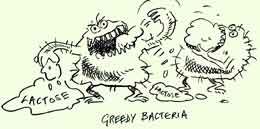
tickers! So what happens if you don't have enough lactase? If you don't break down lactose, or any carbohydrate in fact, in the small intestine it ends up in the large intestine where there are millions of greedy bacteria ready to digest lactose and other sugars for you. You will cross the lactose rubicon and feel ill.
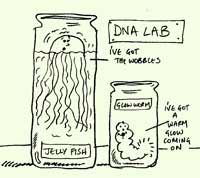
In our guts we all have about 100 times as many bacterial cells as cells in the rest of our body. And there are over 400 different bacterial species there. There is very little oxygen in the lower gut. So, unfortunately, when the bacteria here try to digest lactose, they end up releasing gases and a range of small organic molecules. The two main gases are hydrogen and methane, causing the gut to expand, with inevitable pain. Measurement of these in the breath is useful in diagnosing if you have a low lactose threshold. The small organic molecules can be absorbed into the blood where they get transported to the brain, muscles, joints and so on where they have their toxic effects. It is the absorbed toxins we believe cause the huge range of symptoms. We are on a hunt now to identify these toxins, and see how they work. Through my work as a medical biochemist working on light-producing animals I have developed a revolutionary new technology using DNA from jelly fish and glow-worms. It is helping us show how the toxins work by lighting up chemical reactions in living cells. First Food Intolerance Clinic in Wales A few months after Stephanie's eureka moment, we had a friend around for lunch. During the meal we told her our story. Her mouth dropped open in amazement. 'But that's what's happening to me,' she exclaimed. Then, our story started to get around the hospital where Stephanie works. (She has a special interest in cholesterol, and runs a clinic that helps people and their families who have high levels, and thus are at risk of having a heart attack.) Colleagues, and local GPs, started to refer cases they had that were similar to Stephanie’s. She began to be overwhelmed, and now has over 700 patients on her list whose lives, like hers, have been transformed by coming off lactose. Misdiagnoses There have been some amazing stories – people who have been ill for 10 years or more; a patient misdiagnosed with rheumatoid arthritis and awaiting a knee replacement, and patients previously taking various drugs. All are now cured, and off all medication. What a marvellous relief for them - and a saving for the NHS!
The Fallout But it has not stopped there. Lactose-free cooking I also love cooking. I call it biochemistry in the kitchen. So I converted all our favourite the recipes into lactose free ones. To do this I had to look very carefully at the food labels, as I discovered that over the last 40 years a huge lactose industry has built up, adding milk products and lactose to foods and drinks without being properly labelled. In the US alone the current production of lactose is about 300 million kilograms a year. So what could we advise our patients to eat? They were desperate to enjoy their meals again. The answer was to write a recipe book especially for them. The book, Tony's Lactose-Free Cookbook, contains over 100 mouth-watering recipes, but also explains exactly what lactose intolerance is and how you can have food and drink without lactose. It also explains my own eureka moment. Charles Darwin... As I learnt more about lactose I realised that the symptoms we had uncovered explained, for the first time, the illness that afflicted Charles Darwin for over 40 years. It almost prevented his voyage on the Beagle. Darwin missed something else - the crucial importance of lactose in the evolution of mammals and our own species. The key rubicon question is: 200 million years ago, what came first, lactose or lactase? The answer I believe will revolutionise our understanding of the true origin of our own species. Tony's Lactose Free Cookbook
costs £14.99 from the Windsor Bookshop Further reading 1. Campbell AK (2003). What
Darwin missed. Astrophysics and Space Science 285:1-5 First published in 2006 Click here for more articles on lactose intolerance
|